






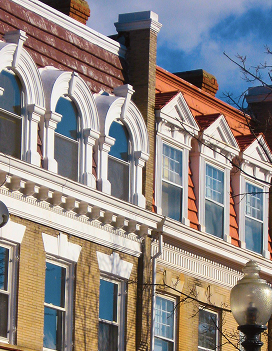

Brick masonry remains a defining feature of older buildings, where the condition of the wall depends on how its materials work together.
Spalling brick in Washington DC is one of the most common brick problems we see, and one of the most misunderstood. When a brick face starts flaking, chipping, or crumbling, it is easy to assume the brick itself is the problem. On an older building, though, that damage can point to moisture, mortar deterioration, or other conditions affecting the surrounding wall.
Brick Spalling at a Glance
Brick spalling is when the face of a brick flakes, chips, or peels off. It leaves a rough, pitted spot on the wall.
Common causes:
- Water gets into the brick and freezes in winter.
- Worn mortar joints let moisture in.
- Hard modern mortar is used on soft, old brick.
- Hard cement coatings or sealers trap water inside the wall.
How spalled brick is repaired:
- Find and fix the source of the water.
- Carefully remove the damaged brick and loose mortar.
- Set a matching brick and repoint the joints with compatible mortar. See our tuckpointing service.
- Clean the wall and check the nearby joints.
Not sure how bad the damage is? Learn about our brick repair and historic masonry restoration work.
The tricky part is that the damaged brick is often only where the problem becomes visible. The cause may involve what is happening in the mortar joints, how moisture is moving through the wall, or how the masonry has been repaired in the past. The brick is telling you where the deterioration showed up, not necessarily where it started.
What Is Spalling?
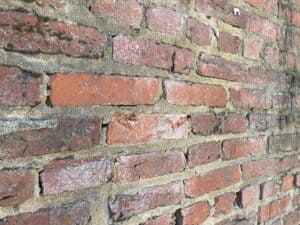
This older brick wall shows localized spalling along with recessed joints and other signs of masonry deterioration.
Spalling occurs when the outer layer of a brick breaks away from the body of the unit. The result is often a rough or pitted area where the original surface has been lost. Minor spalling may affect only a small section of the brick, while more advanced deterioration can remove a substantial portion of its face.
The appearance can vary considerably from brick to brick. What matters is the loss of the original brick surface, rather than a simple line or fracture running through the masonry.
Why Does Brick Spall?
Moisture penetration and freeze-thaw cycles: Water gets into porous brick through worn mortar joints, cracks, and other openings. During a freeze, that water expands inside the masonry. Repeated freezing and thawing puts the brick through the same stress over and over, and eventually the face can start to let go.
Incompatible mortar: Older brick and mortar were intended to work together. Historic mortar is generally softer and more permeable, while a hard cement mortar can behave very differently. When a rigid mortar joint changes how moisture and movement are accommodated within the wall, the brick may end up bearing more of the stress.
Painted brick: Paint changes the surface of a masonry wall. Instead of allowing moisture to move out through the brick as readily, the coating can slow that drying process. On a historic wall, keeping moisture in the masonry for longer periods can contribute to brick deterioration.
Age and natural weathering of soft historic brick: Some historic brick is relatively soft compared with modern brick. Decades of rain, freezing temperatures, heat, and moisture exposure add up. The brick does not suddenly become vulnerable because it reaches a certain age, but years of weathering can leave its surface less able to withstand additional stress.
Why DC Historic Brick Is Especially Vulnerable
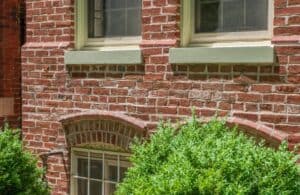
Arched openings and detailed brickwork are among the masonry features that distinguish DC’s historic rowhouse façades.
Washington, DC has a substantial stock of brick rowhouses dating from the 19th and early 20th centuries, which means the brick has been in service for a very long time. Its age alone does not cause spalling, but it is part of the context when evaluating deterioration.
Historic brick was commonly softer and more porous than modern brick. It was designed to work with mortar that accommodated moisture movement rather than forming an especially rigid barrier. When harder cement-based mortar is introduced during a later repair, the relationship between brick and mortar changes, and the original units may become more susceptible to deterioration.
DC’s combination of moisture, temperature swings, and winter freezes puts strain on historic brick. Water that enters the masonry can freeze and expand during cold weather, then thaw as temperatures rise. Repeated freeze-thaw cycles contribute to deterioration of the brick face, particularly where mortar has already been worn down or previous repairs have changed how the wall handles moisture.
How to Identify Spalling vs. Other Brick Problems
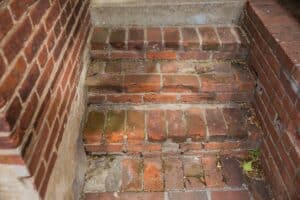
Localized loss along the brick faces is visible among the weathered masonry in this older stairway.
A spalled brick tends to look as though pieces have been peeled, chipped, or worn away. You may see a rough depression where the original fired finish has disappeared, with some areas showing more loss than others. The key distinction is that part of the unit itself is missing.
A crack leaves a visible line rather than removing the brick around it. It might run across the face, through the body of the unit, or along an edge, and its pattern can provide clues about the condition of the masonry. Cracking and spalling sometimes appear together, but they describe two separate forms of deterioration.
Efflorescence is easier to recognize by its white, powdery appearance. It forms when water moves through masonry and deposits soluble salts as it reaches the surface and evaporates. Unlike spalling, it does not involve the loss of the brick itself, although its presence shows that moisture is traveling through the wall.
Can Spalled Brick Be Repaired or Does It Need Replacement?
The extent of the damage determines how a spalled brick should be treated. A shallow area of face loss does not necessarily justify removing the entire unit. Where the brick remains sound underneath the damaged area, a localized repair may be enough.
Replacement becomes more appropriate when deterioration has removed a substantial portion of the face or penetrated deeply into the unit. On an older rowhouse, the replacement brick also has to fit the existing masonry in size, texture, color, and physical characteristics.
There is also a larger question behind the damaged unit: what caused the spalling? Moisture entry, deteriorated mortar, incompatible past repairs, or another condition may be contributing to the loss. Treating the brick without accounting for that underlying issue leaves the wall susceptible to continued deterioration.
What Happens If You Ignore Spalling?
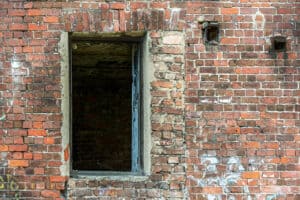
Extensive brick deterioration around this opening shows how masonry damage can spread beyond the first visibly damaged areas.
Once the brick face starts coming away, the softer material beneath it becomes more exposed to moisture and weathering. Small areas of loss may expand, and nearby bricks may begin showing similar wear. What starts as a handful of visibly damaged units can therefore become a larger repair area over time.
Openings in the masonry also make it easier for water to reach places it should not. Persistent dampness behind the facade may contribute to further decay in the brick and mortar and, depending on the location, allow water to reach the interior of the building.
The stakes are higher when substantial portions of a wall have deteriorated. Spalling on a nonstructural surface is not equivalent to widespread material loss in load-bearing masonry, where the condition can have implications for the wall’s stability. That distinction is one reason significant or spreading spalling deserves professional attention.
Next Steps for DC Homeowners
Spalling is a symptom, not always the root cause. A brick may be the first place you notice a problem that began somewhere else in the wall. An on-site evaluation can show how extensive the spalling is, what else is happening nearby, and whether the affected units still have enough sound material to remain in place.
From there, the repair decision becomes clearer. Some buildings may need only limited brickwork, while others may have mortar or moisture problems that should be resolved at the same time. The important thing is to understand the condition before deciding what to remove, replace, or repair.
Spalling Brick in Washington DC: Repair or Replacement?
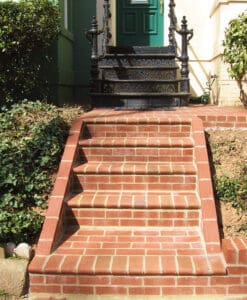
Restoration of historic brick stairs and masonry work with detailed tuckpointing at a classic home entrance.
A damaged brick is not automatically a reason to replace every damaged unit. The extent of the face loss, the condition of the surrounding mortar, and the source of moisture all play a role in the repair.
Renaissance Development provides brick repair and historic masonry restoration for spalling brick in Washington DC, and other masonry concerns on older buildings. Contact us for a free estimate and we’ll help you figure out what your masonry needs.
Frequently Asked Questions
What is the difference between brick repair and tuckpointing?
Tuckpointing addresses failing mortar joints, while brick repair addresses damaged or deteriorated bricks. The two may be needed together when mortar failure has contributed to brick damage.
Can damaged historic bricks be matched and replaced?
Yes, though matching historic brick requires care. Replacement brick should be compatible in size, hardness, and appearance with the original. Hard modern brick can create problems in an older soft-brick wall.
What causes brick to crack or spall on DC rowhouses?
Moisture penetration combined with freeze-thaw cycles is a common cause of spalling brick in Washington DC. Water can enter through failed mortar joints, saturate the brick, freeze, and cause the face to break away. Incompatible mortar repairs can accelerate the process.
Do DC historic properties have preservation requirements for masonry repair?
Properties in DC historic districts may be subject to preservation review and applicable guidelines. The Secretary of the Interior’s Standards for Rehabilitation provide a widely used framework for work on historic properties. Renaissance Development is experienced working within these requirements.
How do I know if my brick needs repair or just tuckpointing?
A proper site evaluation is the most reliable way to assess this. Visible brick damage, including spalling, cracking, or displacement, may indicate that brick repair is needed alongside or in addition to mortar work.
Disclaimer: Every effort is made to ensure the accuracy of the information in this article. Please credit rendevdc.com when sharing and reposting.


